Plotter or Pantser

I was in the mood for a holiday comedy. On Turner Classic Movies I found We’re No Angels (1989) starring Robert De Niro and Sean Penn, escaped convicts posing as priests until they can flee into Canada. Sounded as much like a Christmas movie as Die Hard, but I’d never seen it. Perfect. 

The film that streamed through the TV did not match. It was the 1955 version starring Humphrey Bogart. Not what I planned. I prefer vintage movies, so I stuck with it. A thief, Bogart, and two murderers, escape a prison in French Guiana on Christmas Eve. In a port city they find work with a merchant and his family who run a failing supply store. The convicts plan to steal clothing, supplies, and cash from the family and escape to France on a ship in the harbor.  

The convicts become useful in the store collecting debts from customers and making repairs. They prepare a wonderful Christmas meal for the family. When the wealthy ship owner, a relative, attempts to take over the store, the convicts intercede. One of the convicts has a pet viper that conveniently poisons the rich relative and his mercenary nephew. Bogart forges a new will so that the family inherits the shipbuilder’s wealth. The three convicts conclude prison life wasn’t so bad and head back to Devil’s Island prison sporting halos. 

Nothing in the film went as the characters had planned. Yet, everything worked out beautifully. That’s what made it entertaining. Plans gone awry are the key to the hilarity of Christmas Vacation and Home Alone, two other favorites. Who can’t identify with plans gone awry? 

I’m a planner. I’m uncomfortable letting things out of my control. Life in general goes more smoothly with a plan. But life has its own agenda. I’ve had a taste of plans that hit a wall, lead into an abyss, or disintegrate before my eyes.  

Authors who plan novels before writing are called plotters. They make an outline of the entire plot and know what will happen. Plotters know where they’re going and how they will get there. The opposite of a plotter is a pantser. Pantsers plan very little and enjoy the freedom to “fly by the seat of their pants.” Pantsers write with uninhibited creativity. They enjoy travelling without a map.  

My writing style matches my approach to life. I make an outline all the way to the conclusion, as if that is what will happen in the story. I’ve learned to be flexible because as the story unfolds, the characters take on a life of their own. The plans shift, but in the end, everything works out beautifully. 

I will make a few plans for 2024. But I’m going to keep it loose, be more of a pantser. The year that erased every plan, 2020, gifted me with cherished months I never expected to have with my son and granddaughters. Who knows what surprises await in the new year when plans go awry? 

How will you approach the new year, plotter or pantser

Our Alluring Tree

There was only one weekend left before the big holiday, and we were running out of time to get our tree. My husband, Paul, begrudgingly accompanied me to a local tree farm and we sawed down a blue spruce tree. Paul hastily dragged the tree through the snow to our pickup and hoisted it into the bed, oblivious to the nostalgic value of this occasion. In less than five minutes we were home, rushing so that Paul wouldn’t miss the big game on TV. 

Luckily our son, Reed, was home when we arrived, so he seized one end of the tree and helped Paul push and shove the tree through our front door and then wedge it into the tree stand. I didn’t dare suggest spinning the tree to be certain the bare side wasn’t showing, or the crooked trunk revealed. In a flash my two helpers disappeared into the basement to resume their preferred project, preparing the fishing tackle for winter storage. While they watched the Steelers, Paul and Reed changed or sharpened hooks on hundreds of wooden and plastic fish facsimiles. 

I stood by the aromatic spruce, resignedly pinning on the lights and questioning why I was doing this alone. As I descended to the basement to retrieve the musty old boxes of ornaments, I observed Paul filing the hooks on a bumble bee, a ten-inch oblong lure, painted like its name with mustard yellow and black stripes, a brilliant crimson streak just under the plastic lip. In that instant my mind conjured a Christmas tree display I had visited last year at our local library. Each tree portrayed a unique theme. Some trees wore items that weren’t even actual ornaments, but collections that the decorator had acquired. 

I spoke impulsively. “Why don’t we decorate our tree with musky lures this year?” It worked! Within the hour, our tree was bedecked with grandmas, believers, and spinners in kaleidoscope colors. I had never seen the guys participate with such enthusiasm in any holiday activity prior to this. 

Conveniently, the lures come right out of the tackle boxes with built-in hooks, so there were no boxes to open, no tissue paper to unwrap, and no hauling boxes from the basement or attic. Most of the lures spend the winter hanging from little ledges in our basement. 

We selected the lures for the tree based on color, their unique designs, or their nostalgic value. Just as families reminisce about traditional ornaments and their history, we talked about which lures worked in which lakes, the lure on which Reed caught his first fifty-inch musky, the lure that was lost in the bottom of a lake and found a year later by a friend of ours. We discussed next year’s fishing vacations and which lures to retire or get repainted by Sandy, the lure painter. 

Our tree looked beautiful with the radiance of a glitter perch, a mother-of-pearl shad, and a hot orange crawdad nestled among the boughs in the glow of the twinkling lights. No garland was necessary either. We had the feathery pink, chartreuse, and iridescent gold streamers of the spinners to add texture and elegance. 

The musky lure tradition persisted for sixteen years, except for one year when our black Labrador retriever was a puppy and we feared he would be hooked. In 2011 the inventory of musky lures relocated to Ontario, now stored in Reed’s garage and used for fishing the St. Lawrence River. No sparkling glass balls or commercial trimmings could ever supplant those lures as prized Christmas tree ornaments. 

Prickly Signs

Signs are always so clear in hindsight. Last week after a walk, Goldie hoarded something in her mouth. I’ve had to pry small objects from her jaws before, from acorns to moles. This time I found a porcupine quill sitting loosely on her tongue. I don’t know whether porcupines shed their quills like Goldie sheds fur or like humans shed skin cells. Nevertheless, she discovered it amid grass and leaves. I shuddered at the thinly spiked point and tossed it away. That’s exactly why Goldie is always on a leash. 

We have at least one neighborhood porcupine who makes a daily trip to the river and back. Usually, I spot it lumbering through the back yard early to midmorning. It heads to the high rocky cliff at the edge of our property. Goldie calmly watches it from our sliding doors. If I have Goldie on a walk and we spot the porcupine, I do an immediate about face. Goldie has keener senses than I have. On several occasions she stopped dead in her tracks and looked up into a tree. The porcupine was perched on a limb gnawing away.  

Earlier this week I admired a decorated pumpkin in my doctor’s office. The creator had used 900 toothpicks to create Henrietta, the porcupine. I marveled that a busy healthcare giver would have the time and especially the patience to paint each toothpick black at one end, then carefully insert each one at regular intervals. At the time, I simply enjoyed the whimsical design. I made no connection to our local resident. 

Up early today, I put on a pot of coffee and gave Goldie breakfast. Our first trip outside is usually after dawn, but today it was still dark. We have no streetlights. I grabbed a flashlight so as not to break the cardinal rule: don’t fall. We walked to the end of our driveway. Goldie’s ears perked up and I suspected she caught the scent of the whitetail deer family who have been grazing on acorns. I aimed the flashlight in front of me with my left hand and held the leash with my right. We proceeded to the edge of the woods. I hoped she would do her business quickly. 

Without warning she made a lunge into the black shadows on the side of the road. My arm about came off as I struggled to hold her back with one hand on the leash stretched to its maximum length. I shouted angrily while engaging in a tug a war. She shot out of the brush like a rocket. Her snout looked like Henrietta the pumpkin, a massive array of white quills. I dragged her by the collar back to our house while she madly battled the quills. 

Paul quickly located pliers and lighting, while I pinned Goldie. Goldie is 65 pounds of muscle, and I am a 120-pound weakling, so we had a long tough wrestling match. Paul must have removed more than 50 quills around Goldie’s nose, then did his best to pull the ones from inside her mouth while I held her jaws open. The place looked like a porcupine had been killed by the time we finished, blood and quills on us and the carpet. Two hours later we dropped her at the vet’s where they anesthetized her to remove remaining quills. She’ll be fine. 

Before today, I believed a porcupine would never be one of our problems. Even on her leash, Goldie found one. No matter how we prepare to keep ourselves and our loved ones safe, unexpected events will still happen. We might miss obvious signs. Or we are blindsided, no warnings, even if we are vigilant. We’re left to do our best in the aftermath. 

I’ll be walking Goldie again tomorrow. Daylight walks only.  

Eliminations


Late summer offers plenty of televised sports. We watched PGA golf, pre-season NFL football, and the Little League World Series. Every sport eventually gets down to the elimination phase, the final tournament in which the best contenders play one another to determine the ultimate champion. The winner receives a trophy, a medal, or some other coveted prize.

An elimination tournament has been playing out year by year in my life. I just now recognized it. Seems the competition began years ago. The winner of my tournament earns the right to be eliminated…forever. No rematches. No return as challenger. No next season appearance. Gone for good! Only the competitors who lose preliminary matches are seen again.

Instead of regional rounds, my contest has seasonal rounds. For example, summer has plenty of contestants: water sports, land activities, amusement rides, etc. Years before I ever knew this was a competition, roller coasters won. They spun and gyrated beyond my tolerance. Ferris wheel, with a steady revolution, never had a chance. Year after year more summer activities claimed the title. Forever gone are carnival rides, sports on wheels, and anything towed by a speed boat. Jumping is a past winner. That includes jumping into leaves, jumping on trampolines and beds, and jumping off cliffs, boards, boats, and docks. Hopefully, no more jumping through hoops.

Every season has its favorites, but winter claims several champions. Downhill skiing and ice skating took crowns years ago and haven’t been seen since. Cross country skiing is still in contention as well as snowshoeing. Driving at night has winning potential, especially in winter. Fall and spring don’t produce many challengers, unless you add a ladder to the task. Adios to running in any season. Sayonara to tent camping.

A winner can come out of nowhere. Vying for top place this year were hiking in the mountains of Vermont and cleaning the gutters on a stepladder. Surprise, surprise. Two weeks ago, I visited Rock Island Lighthouse with my granddaughters. When we reached the tall structure, I sent the granddaughters up the spiral staircase to the top alone. Farewell forever to lighthouse lookouts.

This tournament just gets more popular every year. Like other sports play-offs, maybe I should add a theme song, say Another One Bites the Dust or Sittin’ on the Dock of the Bay. For now, hot dogs, pizza, and beer are still viable vendor snacks, so long as the antacids do their job. As for sponsors, I’m sure AARP could cash in.

Until the championship comes down to driving and independent living, I’m grateful to enjoy the sidelines. Plus, I have my reliable three: reading, writing, and painting, all non-competitors.

Turtle Karma

I drive along County Route 100 when Paul shouts, “Stop!” I check the rear-view mirror, hit the four-way flashers, and pull over. Paul bolts from the car. He grasps a spotted turtle who sits in the middle of the road and advances the turtle into the grass, the direction it was headed. Turtle season begins as various species emerge from the river and ponds to lay eggs. Our roads apparently intersect prime nesting grounds. 

The sensible way to move a snapping turtle is with a plastic snow shovel, carried in the bed of our truck for that purpose. A snapper can be 18 inches in diameter and weigh around 13 pounds.  A foot long snapper can stretch its neck 9 inches to bite.  

When turtle eggs are buried on our property, our sense of responsibility deepens. Every year a snapping turtle makes a nest along our driveway. She arrives before dawn and excavates a cavity. For several hours, she tilts herself over the hollow depositing eggs. Then, she scrapes the soil completely over the egg chamber and returns to the water. The eggs incubate for about two months. 

Last year a predator raided the nest within the first twelve hours. So, this year Paul had a coil of wire fencing and metal posts ready to build an enclosure around the nest. Last Saturday morning the mother snapper arrived and fulfilled her mission. By noon Paul and I had the area enclosed and securely staked. No raccoon, fox, skunk or coyote would prey on the eggs this year. 

Sunday morning, I found a pile of loose soil and broken eggshells inside the secure enclosure. The fencing had not been disturbed in any way. The predator had squeezed through the two-inch by four-inch openings. We hadn’t accounted for a mink, that can squeeze through an inch-square opening. We had failed the turtle.  

We dismantled the pen. I tried imparting wisdom. We are not supposed to interfere with the patterns of nature. Other nests might be successful. Only 10% of turtle eggs hatch. 

Paul was not hearing it. He wasn’t giving up. We could see undisturbed eggs deep in the chamber. I raked the soil back over the cavity. Paul flattened the same fencing into about six layers so openings would be less than an inch. Over top of that we placed a campfire cooking grate. We staked the thick mesh rectangle over the nest and weighed it down with bricks. I marked our calendar so we could uncover the nest a week before hatching. 

Monday morning, I found a three-foot tunnel dug from outside the barrier to the egg chamber. The remaining eggs had been destroyed. Now we felt dejected and outsmarted. I read that a snapping turtle is at the top of its food chain. Evidently, turtle eggs serve the broader purpose of feeding night prowlers. We disassembled the barricade and accepted the fate of turtle eggs. 

I had one more lesson to learn. After resolving the turtle egg episode, Paul took the truck to run errands. I returned to the house to take Goldie for a walk. My phone, used to measure steps, was nowhere to be found. I had the sinking feeling that I left it on the bumper of the truck after I snapped pictures of the egg carnage. Using the land line, I reached Paul, who returned to the house. We drove slowly along the roads while I scanned the ground, in tears over the lost pictures I never backed up on my computer.  

The local greens keeper drives the mower on our roads, so Paul pulled over so I could ask him if he’d seen the phone. I stepped out next to a pond. I looked down. Not two inches from my foot was my phone, screen side up in perfect condition.  

“You won’t believe this,” I said to Paul. I picked up the phone and showed him. “It was the turtle! She led me here.” 

Dedicated efforts don’t always conclude the way we expect. But I guarantee that virtuous intentions return as good karma. In this case turtle karma. 

Pest Perspectives

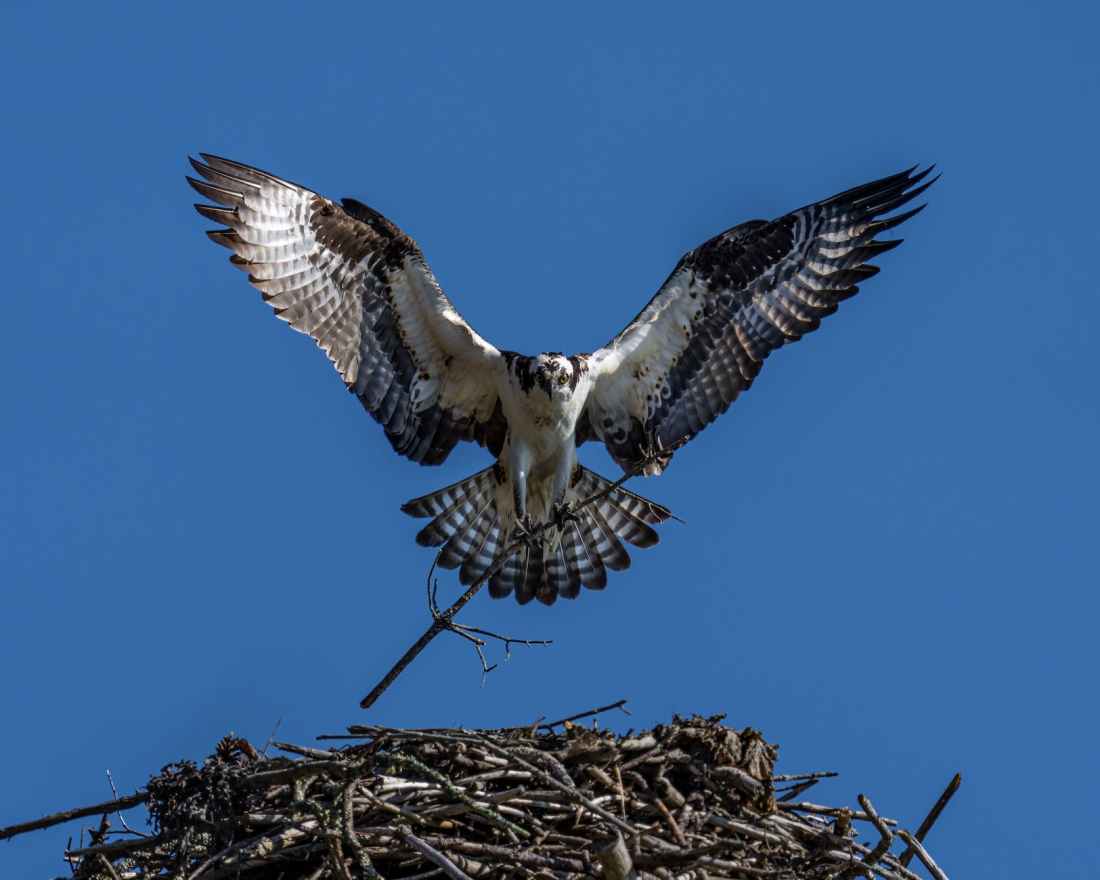
Wildlife Viewing. This weathered sign greets mainlanders who arrive on the island where I live. Wellesley Island offers woodlands, grasslands, marshes, and shoreline. Deer, turkey, fox and porcupine frequent the open land along the roads. Beavers, muskrat, osprey, and herons inhabit the bays and canals. Birdwatchers come to spot songbirds. Campers at the state parks hear the mystical calls of loons and owls in the night. 

The novelty of wildlife fades when visitors become residents. The black squirrel is scorned for severing tree branches and the chipmunk for burrowing in the perennials. Coyotes are disparaged for their predatory nature and the geese for their prolific waste. Another sign, newer and five times larger, offers pest control. There’s never just one. Eaves are sprayed for spiders, foundations for ants. Our neighbors trap and relocate a woodchuck and a raccoon.  

This is an old story. We believe our needs and habits take precedent over those whose land we have usurped.  

I hang wasp decoys on all sides of the house. Like Chinese lanterns, they are orb-shaped to resemble paper wasp nests. I read that wasps will not infringe upon other wasp territory. A tin owl suspends below our porch light, to discourage birds’ nests, only because our comings and goings would prevent parents from caring for the eggs and hatchlings. Goldie does her best to chase the squirrels off the orioles’ oranges. But the savvy squirrels feast on the oranges when Goldie and I take our walk. 

Despite discouragement, the so-called pests persist. The bats spend their days tucked into the folds of our patio umbrella. Rogue black ants scuttle across the counter after a heavy rain. Spider webs glisten outside the kitchen window. The ticks find their way into our house on Goldie. We give plenty of leeway to the snapping turtle who annually buries her eggs by our lamppost. 

When wildlife crosses our arbitrary boundaries, we lose sight of Mother Nature’s complex system. Yet, because of her scheme we can marvel at the gobbler’s fan, admire the delicate leap of a deer, and wonder at the engineering of a beaver dam. All creatures have a gift or a purpose in a design much bigger than the one we comprehend.  

As is often the case, a change in perspective fosters deeper understanding. I vow to be more benevolent toward all living things, animals and people alike. 

No Better Friend

Think of the charismatic friend that you haven’t heard from in almost a year. She’s the impulsive one known for her mood swings. She arrives unannounced, scolding you for moping around the house in your wool socks. She insists you drag the chairs out of the garage and light the grill. You mix boat drinks. A flock of robins stops by. Birdsong and flights of honking geese play as a soundtrack. A warm south wind carries off the winter dust and the sun glows. You haven’t felt this giddy since sometime in December.  

She calls herself Spring but refuses to be a stereotype. She’s temperamental. She throws stormy tantrums that can rip shingles off a house. She gets weepy for days on end sending all the creeks over their banks. A day after your reunion, she gives you the cold shoulder. Snow falls on your tulips and you scramble to protect your bleeding hearts from a hard freeze. An arctic front chases you back into the house. The furnace growls. You knew Spring was unpredictable, but she dazzled you…as always. 

A week later contrite Spring returns to your door in emerald-green velvet holding bunches of daffodils prepared to paint your sky cerulean blue. You forgive. She’s invited a few others, the ground hog, the chipmunks, and the redwing black birds. The temperature trends upward. Fresh-cut grass perfumes the air. Unlike Winter, Spring never overstays. Before she leaves, she makes sure the goslings hatch, the trillium blooms, and the orioles build their nests. She loathes goodbyes, so she’ll leave without warning, heading to regions north. 

Suddenly, you’re under the stifling glare of Summer, complaining about the heat, missing Spring’s cool nights. Within six months a cold-hearted Winter will move in for an extended residency. By then you will have forgotten Spring’s faults. You will long for the scent of lilacs and the sight of swans drifting on the water. In your memory every Spring day shimmered lush, green and brilliant blue. 

You will find no better friend than Spring. She dispels the gloom, enlivens the days, and draws you into the sunshine.  

The Nature of Dirt

Winter’s dirt is getting ahead of me. Birdseed and sunflower-seed shells migrate into the house from the deck on the soles of our shoes, scattering across the carpet like confetti after a celebration. Fine ash drifts out of the wood burner settling on all horizontal surfaces. Sand from the road drops out of boots and paws. Pieces of gravel resist the suction of the vacuum and after a few spins in the roller ricochet free. Golden dog fur weaves into carpets or mingles with dust to form roving tumble weeds. I call myself the Queen of Clean. Dirt is an easy fix. 

Doubt is a lot like dirt. It settles under the skin like grit settles under the carpet edges, grinding away, undermining conviction. Doubt clouds the vision. It distorts the view like the nose prints on our sliding glass door. Goals that once appeared crystal clear dull under a dusty haze. Doubt can take an aspiration and soil it so that one is tempted to discard the idea altogether. Whatever a person hopes to achieve can be ruined by doubt’s dirty habits.  

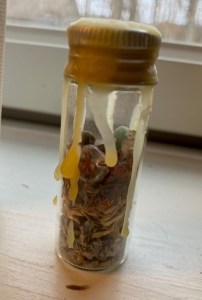
My surefire solution for dirt includes hot water, Murphy’s Oil Soap, and a can of Liquid Gold. If absence of dirt defines clean, then absence of doubt defines confidence. I’m not the queen of confidence. I don’t have a solution for doubt in my cupboard. It spreads like mildew through my writing goals. My granddaughter concocted a confidence-spell, a little vial of blended herbs and select crystals sealed with yellow wax. I place it nearby when I write. As a last resort I rely on positive affirmations from the Truvia sweetener packets. If only I could see the Wizard. 

Success builds confidence. There’s the dilemma. How does one succeed with doubt spawning avoidance and fear of failure? I’m going to try spot cleaning. Select one small area and saturate it, like a coffee stain on the sofa. In bits and pieces, I will eliminate doubt and grime from corners. Maybe then confidence will shine.  

I have no doubt about one thing. The house will soon be spic-and-span, because I understand the nature of dirt. 

If you had no doubt about success, what would you attempt? 

Ice Trax for Life

Icy winters on Wellesley Island require traction. Last year I never set foot on ice. If I needed to go anywhere, I headed through the connected garage straight to the all-wheel drive Subaru. Needs change. Our new family member, a three-year-old golden Aussie mix, requires daily walks. Her enthusiasm for sprints jeopardizes the biggest safety objective in my life: DON’T FALL. 

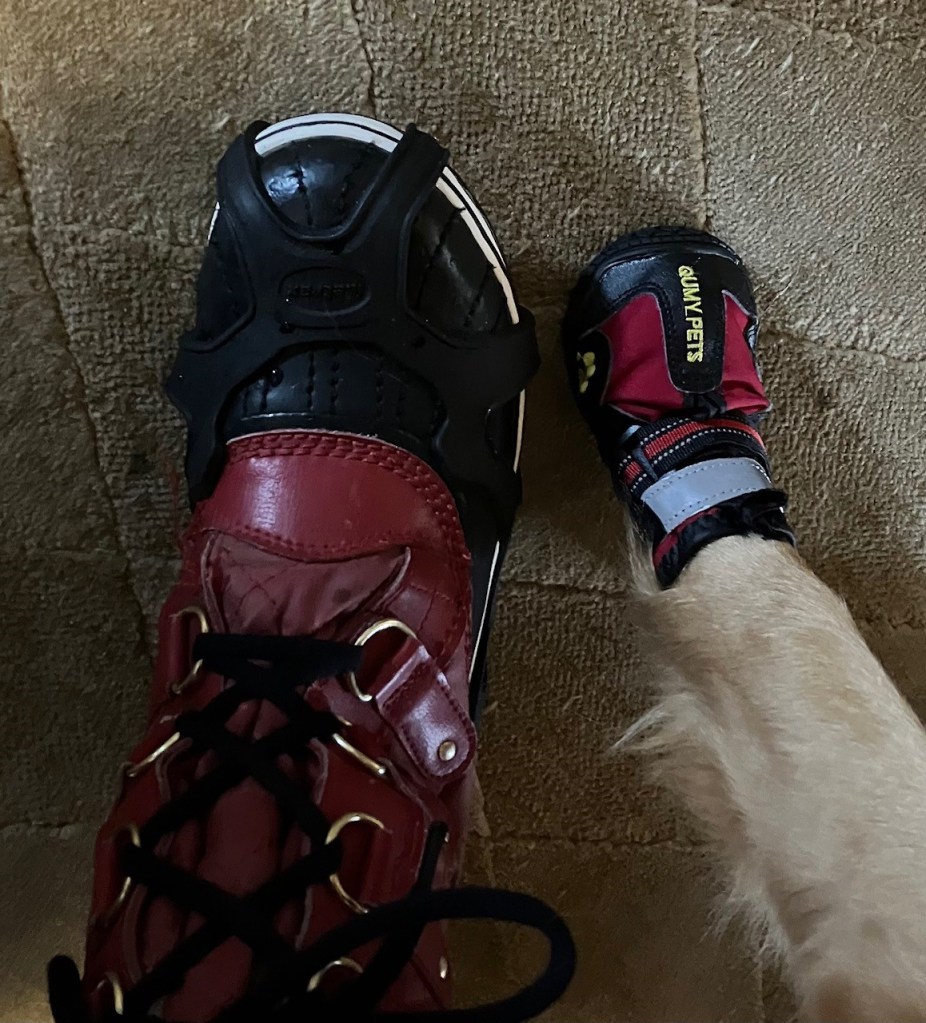
With the first dusting of snow, I pulled on vinyl-soled boots. When the muddy trails froze, I skidded trying to keep pace with Goldie. I ordered heavy duty snow boots that arrived just in time for the December blizzard. The new calf high boots cinch tight with Velcro and have soles like winter tires. Because Goldie’s furry feet gather ice balls like glass marbles, I purchased a set of boots for her as well. We were all set. 

Then a slight warm-up compacted the snow. Freezing rain sealed everything in a glossy coat of varnish. Recurring layers of ice and snow transformed into the slickest substance on the earth. I didn’t dare step out the front door. 

I now have Ice Trax, flexible straps that stretch over boots with nine metal spikes to puncture the ice. I’m as sure-footed as a mountain goat. 

Winter days indoors are just as slippery in their own way.  I wake up early, get Goldie out, complete the morning tasks, and sit down with a cup of coffee. That’s when I lose traction. I spend the next hour on the crossword, scroll through Pinterest boards, or watch the birds devour seeds. I need to get a grip on the day.  

I added a day planner, sort of like boots with heavy treads. It’s not just another calendar, but a place to make to-do lists. All my desired accomplishments can be recorded and checked off as completed. It works on days when items are Empty the dishwasher or Call to schedule an eye exam. If I’m expected to show up someplace, I can navigate that. But as soon as the list includes something like Organize the closet or Paint the ceiling, I skid. 

Honestly, how important is a clean closet or fresh paint? After all, my decades are numbered…with very low digits. The to-do list works more like dis-traction. Forget tiresome chores. The decade of 70 demands fulfillment. 

I’ve been wrong about life’s traction. Now is the time to get off the navigable trails and get out on the ice. Forget safety, danger lurks within every day. This is not about fall prevention, it’s about standing up for final chances. I have a manuscript to polish, a website to launch, and an author’s platform to build. That’s the worst ice storm I can imagine.  

I’m reviving PowerAgers as my Ice Trax for life. I hope you join me.

The Three-Marker Challenge

My PowerAger friends demonstrate that learning never stops. When they retired from their careers, they took up new hobbies, part-time jobs, and community service.  From kayaking to golfing to biking, directing charities and food banks, working locally and travelling far, they continue to flourish.

I have not strayed from my familiar pursuits. But the gift of extended time with the granddaughters broadened my experience. I learned to do the Floss and I can perform the Cup Song from Pitch Perfect. Give me white glue, activator, shaving cream and I can concoct a cloud slime. I know how to play Wii bowling and the live version of Among Us. The Norris Nuts feel like extended family. Once, I had a brief cameo on TikTok.

More aligned to my inclinations is the Three-Marker Challenge.  Each participant gets a coloring page. Ideally, my son has printed three versions of the same picture from his computer. But any three coloring-book pages can work. The bin of markers is placed within reach. One at a time, we each close our eyes and select three markers. We must color the picture using only those three markers.

Coloring proceeds. Mickey Mouse might have purple ears, an LOL girl could end up with a green complexion, and a nature scene might look like vegetation from another planet. I appreciate how the limited palette requires experimentation in contrast and complement. Best of all, we can let go of what is the “right” color for sky, for animals, or even for skin. Artistry rules.

When I first engaged in this challenge, the girls made it a competition. Of course, the person using beige, brown, and gray had a slim chance to win. Peeking accusations sometimes erupted. On occasion I spotted one of the girls planting a particular color on top of the marker pile in advance. Lately, we simply present our results and relish our originality.

If life is like the Three-Marker Challenge, I do not qualify. I have been gifted a full set of broad-tip and fine-tip Crayola markers arranged in rainbow order. I have the colors to create any life I want. In actual life those who got beige, brown, and gray through the luck-of-the-draw face the coloring bias. How can anyone make an appealing life mural without access to the primary colors? We need all the colors to illustrate life’s nuance. No wonder some resort to cheating.

A few rule changes might establish more equity. Allow returns, exchanges, or trades. Or individuals choose three desirable colors. Maybe four. Even more radical, participants might share their markers. Surely, we can find a way for everyone to start with a basic set of eight.

Thanks to my granddaughters I now have a better understanding of Social Marker Justice.